

How to Show Families Your Season Plan: Quarterly Parent Meetings and Reports They Understand
Every youth coach has been there: a father shouting instructions from the stands that contradict what the team has worked on all week, a mother asking why her daughter plays less than someone else, a group of parents who judge the whole season by Saturday's result. These families almost always have one thing in common: they don't know what is being worked on, towards which objectives, or by which criteria decisions are made.
A club's sports culture and education are not built only in the changing room. They also have to reach the families. This article proposes how to do that with quarterly meetings and easy-to-read reports, what research says about parental involvement in youth sport, and where the limits are.
Why sports culture is also built with families
A family that understands the plan watches a match differently. If they know that this quarter the team is working on playing out under pressure, a turnover in their own half is not a disaster but part of a learning process the coach has chosen to accept. If they know the aim is for everyone to get meaningful minutes, they will understand the rotations. And if they know the selection criteria, they have fewer reasons to suspect favouritism.
Showing the work also sends a message that loose words cannot: behind every session there is a plan, clear objectives and someone supervising each player's progress. That message of quality and method builds trust, and trust is what allows you to ask families to support rather than direct from the sideline.
There is a knock-on effect too: when families watch the match with an understanding of the game and the objectives, the conversation in the car on the way home improves, effort is valued and not just the score, and the stands are more likely to be a place of support rather than pressure.
What research says about parents in youth sport
The link between what parents do and how their children experience sport has been studied quite a lot. A few ideas worth knowing before preparing a meeting:
- Players know what they want from their parents. In a study with adolescent female team-sport athletes, Knight, Neely and Holt found that they preferred support and encouragement, comments on effort and attitude, and no technical or tactical instructions from their parents during matches [1].
- Sideline comments range from encouragement to criticism. Holt and colleagues observed a wide range of parental comments at youth soccer matches, from praise and encouragement to instructions and criticism, and the way parents got involved shaped how their children experienced it [2].
- Pressure goes with less enjoyment. In a sample of young Spanish athletes, Sánchez-Miguel and colleagues found that perceived parental pressure was linked to less enjoyment and more amotivation, while support and understanding were linked to more enjoyment [3].
- Parental presence is not neutral. Bois, Lalanne and Delforge studied pre-competitive anxiety and related it to parenting practices and to parents being present at the competition [4].
- Conflict between adults matters too. Omli and LaVoi described "background anger": arguments between adults on the sideline that children witness even when they are not aimed at them [5].
- Enjoyment is one of the keys to staying in sport. Crane and Temple's systematic review of dropout among children and youth lists, among the most frequent factors, lack of enjoyment, low perceived competence and social pressures [6].
Harwood and Knight, in their position paper on parenting expertise in sport, argue that being a good sport parent is learned, and that clubs and coaches have a role in helping parents understand the context, manage the emotions of competition and build good relationships with the coaching staff [7], an idea also developed in later reviews [8]. There is at least one pilot study in which a 45-minute seminar for parents, with a written guide, had a positive impact on aspects of parental involvement and the parent–child relationship [9]. It is a pilot with a small sample: the results are promising, not conclusive.
We covered how to talk to the players themselves in communicating with young athletes. With families the principle is the same: clarity, consistency and a message focused on the process.
Quarterly parent meetings: why every quarter
A start-of-season meeting is common. The problem is that by October nobody remembers what was said in September, and by March the team is somewhere else. One meeting per quarter has several advantages:
- It fits the plan. Most seasons are organised in blocks of several weeks. Each meeting closes one block and presents the next.
- It shows progress, not just intentions. The first meeting explains objectives; the following ones can show what has been worked on and how the group has developed.
- It corrects things in time. Tension on the sideline or misunderstandings about minutes are addressed before they become entrenched.
- It is manageable. Three or four meetings a year don't overload the coach or the families.
It fits naturally with a season planned in blocks, like the one we propose in how to plan a youth futsal season.
Outline for a 45 to 60-minute quarterly meeting
An outline keeps the meeting short and stops it turning into a string of individual complaints. Here is a proposal that each club and age group can adapt:
| Block | Time | What to show |
|---|---|---|
| 1. Welcome and purpose | 5 min | Who the coaching staff are, what the meeting is for and what will not be covered (individual cases: another time) |
| 2. Objectives for the quarter | 10 min | Three or four clear team objectives, in plain language, with an example of each |
| 3. Content worked on | 10 min | What has been trained and why, with two or three drills shown on the board or on a printed session |
| 4. Group progress | 10 min | Attendance, team progress and areas to improve, without singling out any player |
| 5. Selection and minutes | 5 min | Selection and playing-time criteria, the same for everyone and known in advance |
| 6. Sideline and communication | 5–10 min | Sideline rules, channels for contacting the coaching staff and when to talk after a match |
| 7. What families can do at home | 5 min | Rest, nutrition, and questions about enjoyment and effort rather than the result |
| 8. General questions | 5 min | Group questions; individual ones are scheduled separately |
Objectives for the quarter and content worked on
This is the most important part and the one most often forgotten. No technical jargon is needed: "this quarter we want the team to be able to play out even when the opponent presses" is clearer than any diagram. Showing a couple of real drills from the plan, on the board or on paper, makes it visible that there is a method behind the work.
Progress, selection and minutes
Talking about progress as a group avoids comparisons. Individual reports are given to each family separately. Selection and playing-time criteria (attendance, attitude, development stage, rotations) should be written down and the same for everyone: it is the best protection against misunderstandings.
Sideline and communication rules
Few and concrete: cheer for the whole team, don't give players instructions during the match, respect the referee and the opponent, and don't talk to the coach about minutes or decisions right after the final whistle, but through the agreed channel and time frame. Explaining the reason behind each rule, drawing on what players themselves say [1], works better than reading out a rulebook.
What families can do at home
Ask "did you enjoy it?" or "what did you learn today?" before "how many goals did you score?". Look after rest and nutrition. And respect that the player also needs time without talking about the match.
Reports families understand: showing each player's progress
A report for families is not a technical report. It works best when it is short, visual and focused on the process:
- Few indicators. Attendance, content worked on and a rating by aspect (for example attitude, technique, game understanding) are enough.
- Progress, not rankings. Compare the player with themselves over the season, never with teammates.
- One positive comment and one challenge. What has improved and what to work on next quarter.
- Same format for everyone. Families trust the process more when they see everyone receives the same thing.
Minors' data: what is shared and what is not
Before showing anything, a few basic rules should be clear. This section is not legal advice: each club should review its situation with whoever advises it.
- Consent. A minor's data is handled with their family's authorisation and the information required by the applicable rules.
- Each family gets only their own child's data. Never reports or ratings of other players, and no comparative lists.
- In the meeting, group data only. Nothing that identifies a specific player.
- Health data is not shared. Injuries and wellbeing data are health data: they are not included in these reports or sent through group channels.
How PiSportDesk makes it quick and simple
Preparing a meeting like this takes time if the plan lives in a notebook, attendance in a spreadsheet and drills on your phone. PiSportDesk brings all that work together and lets you pull out what families need in a few minutes. This is what exists today:
- Planning and calendar. Sessions are placed on a weekly, monthly and season calendar. The week or month can be exported as a PDF, and dates, times and venues can be shared by link or QR code.
- Objectives. You set season objectives and each session carries its own; the full session, with its drills and objectives, can be exported as a PDF.
- Each player's profile. In People, the profile summarises attendance, rating by aspect, time spent on each content area, matches and minutes, by season, cumulative or by date range. "Share my evolution" creates a link or QR code with that summary; the data travels inside the link, without going through a server, and opens in PiSportDesk in the browser. That summary does not include injuries or wellbeing data.
- Matches. From Live Analysis, a player's stats for a match can be shared by QR code or as a PDF.
- Drills. Library drills can be exported as a PDF, so you can show families what a real exercise looks like.
Important: PiSportDesk does not currently have a portal or a separate login for families. What reaches them is a PDF, or a link or QR code that the coach chooses to create and send.
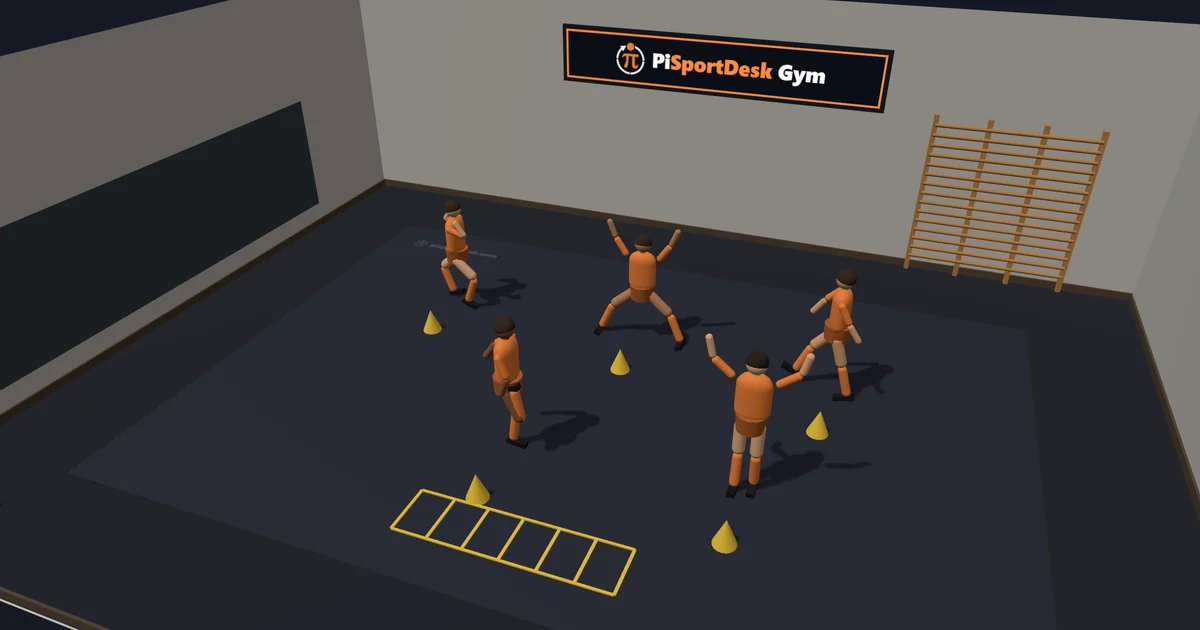
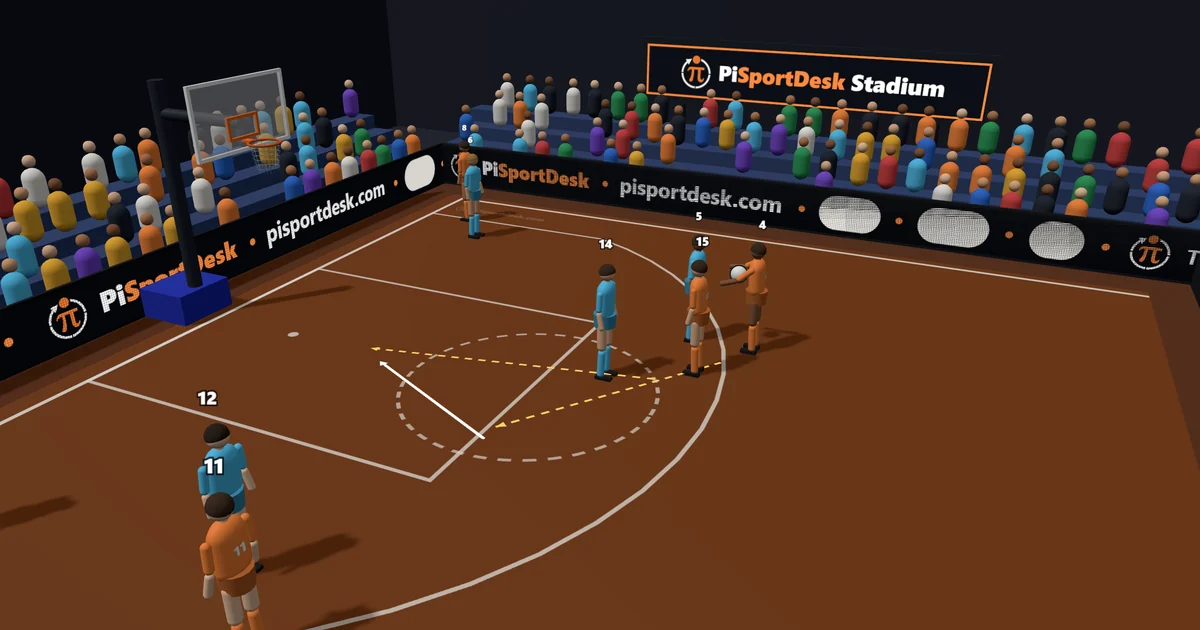
The tactics board helps in the meeting too. Explaining what a "pick and roll" or "playing out under pressure" means with an animated play lets a family with no coaching background understand it in seconds. And it is not just for team sports: in "Other physical activities" the jointed figure lets you show a circuit, a warm-up or a stretch. On the Pro Cloud and Club Cloud plans, the play or exercise can also be viewed in 3D. For clubs with several teams, having everything in one shared base, as we explain in how to manage a multi-team club, makes it easier for every age group to send the same message. All plans, including Free, are on the pricing page.
What a meeting cannot achieve on its own
It is worth being honest. Meetings and reports help, but on their own they do not guarantee a change in behaviour. Some families won't come, others will listen and carry on as before, and some situations need a one-to-one conversation or the club's intervention. The evidence on parent education programmes is still limited and largely comes from small studies [9].
What does change is the starting point: a club that explains what it does, with which objectives and by which criteria, has more legitimacy to ask for a supportive sideline and more tools to steer conflicts. And consistency matters more than any meeting: if the coaching staff protest every refereeing decision, it is hard to ask families not to.
PiSportDesk brings planning, sessions, player profiles and a tactics board together in one app that works offline and without an account.
Try PiSportDesk freeReferences
- Knight, C. J., Neely, K. C. & Holt, N. L. (2011). Parental behaviors in team sports: How do female athletes want parents to behave? Journal of Applied Sport Psychology, 23(1), 76–92. doi.org/10.1080/10413200.2010.525589.
- Holt, N. L., Tamminen, K. A., Black, D. E., Sehn, Z. L. & Wall, M. P. (2008). Parental involvement in competitive youth sport settings. Psychology of Sport and Exercise, 9(5), 663–685. doi.org/10.1016/j.psychsport.2007.08.001.
- Sánchez-Miguel, P. A., Leo, F. M., Sánchez-Oliva, D., Amado, D. & García-Calvo, T. (2013). The importance of parents' behavior in their children's enjoyment and amotivation in sports. Journal of Human Kinetics, 36, 169–177. doi.org/10.2478/hukin-2013-0017.
- Bois, J. E., Lalanne, J. & Delforge, C. (2009). The influence of parenting practices and parental presence on children's and adolescents' pre-competitive anxiety. Journal of Sports Sciences, 27(10), 995–1005. doi.org/10.1080/02640410903062001.
- Omli, J. & LaVoi, N. M. (2009). Background anger in youth sport: A perfect storm? Journal of Sport Behavior, 32(2), 242–260. No DOI.
- Crane, J. & Temple, V. (2015). A systematic review of dropout from organized sport among children and youth. European Physical Education Review, 21(1), 114–131. doi.org/10.1177/1356336X14555294.
- Harwood, C. G. & Knight, C. J. (2015). Parenting in youth sport: A position paper on parenting expertise. Psychology of Sport and Exercise, 16, 24–35. doi.org/10.1016/j.psychsport.2014.03.001.
- Knight, C. J., Berrow, S. R. & Harwood, C. G. (2017). Parenting in sport. Current Opinion in Psychology, 16, 93–97. doi.org/10.1016/j.copsyc.2017.03.011.
- Dorsch, T. E., King, M. Q., Dunn, C. R., Osai, K. V. & Tulane, S. (2017). The impact of evidence-based parent education in organized youth sport: A pilot study. Journal of Applied Sport Psychology, 29(2), 199–214. doi.org/10.1080/10413200.2016.1194909.