

Working-Time Records at a Sports Club in Spain: What the Law Requires and How to Keep Them Simply
Please note. This article is general information about Spanish law, checked against the Spanish Official State Gazette (BOE) on November 18, 2026. It is not legal or employment advice. Every club has its own collective agreement, contracts and circumstances: if in doubt, talk to your employment adviser or a qualified professional.
In many clubs and sports schools, the employment side grows as the club does: first an instructor on contract for the summer school, then a part-time coordinator, someone in the office and a coach or two on the payroll. The sporting side is well organised, but the hours record often lives on a sheet of paper at the front desk, in a spreadsheet someone fills in when they remember or nowhere at all.
This article explains what Spanish law says about recording working time, who it applies to inside a sports club, what the record must contain and how to organise it without turning it into a burden. At the end we explain how we have approached it in PiSportDesk, on the Club Cloud plan.
What the law says: a daily working-time record
Article 34.9 of the Spanish Workers' Statute (Estatuto de los Trabajadores) states that the company shall guarantee a daily record of working time, including the specific start and finish time of each worker's working day [1]. That paragraph was added by Royal Decree-Law 8/2019 of 8 March, and it has applied since May 2019, two months after its publication in the BOE [2]. In other words, it is not a new obligation: it has been in force for more than seven years.
The law does not set a format. It says the record is organised and documented through collective bargaining or a company agreement or, failing that, by the company's decision after consulting the workers' legal representatives [1]. In practice, that means checking your applicable collective agreement first, in case it already says how to do it.
There is a lot of confusion about digital records. As of this article, the royal decree that would require a digital record has not been approved or published in the BOE: we checked the BOE contents of November 18, 2026, and the employment rule published that day (Royal Decree-Law 39/2026) deals with other matters and does not amend Article 34.9. If a website tells you digital clocking-in is already compulsory under a 2026 rule, check the reference in the BOE before taking it as fact.
Who it applies to inside a sports club
The duty falls on the employer with respect to its workers. A club or sports school that hires staff is an employer, even if it is a non-profit association. What decides whether someone goes in the record is not their role at the club, but whether they have an employment relationship.
| Role | In the record? | Note |
|---|---|---|
| Instructors and coaches on contract | Yes | Including part-time staff, which is the most common case at sports schools |
| Contracted coordinators and sporting directors | Yes | Even if they organise other people's work, their own hours are recorded too |
| Office, administration, maintenance | Yes | These are the staff most often left out of the record |
| Volunteers | No | Under the legal definition, volunteering is not an employment relationship |
| Amateur athletes | Generally, no | If an athlete has a contract with the club, things change: get advice |
On volunteers, Spain's Volunteering Act (Law 45/2015) defines volunteering as a freely chosen activity without financial or material consideration (apart from reimbursing expenses), and excludes activities carried out under an employment relationship [5]. But the line is not always clear: a "volunteer" who receives a fixed amount every month, with set hours and under the club's direction, may not be a volunteer in legal terms. If your club has cases like that, or athletes or coaches paid through unclear arrangements, the prudent step is to get advice before deciding who goes in the record.
What the record must contain and how long to keep it
Based on the BOE text, a working-time record must cover at least the following [1]:
- A daily record for each person. Every working day, for every person on contract.
- The specific start and finish time. "4 hours" is not enough: the time the working day started and the time it ended must be recorded.
- Kept for four years. Records are kept for four years.
- Available to three parties. The workers themselves, their legal representatives and the Labour and Social Security Inspectorate.
One case is very common at clubs: the part-time contract. For these staff, Article 12.4.c of the Workers' Statute adds that working time is recorded day by day and totalled each month, and that the club must give the person, together with their payslip, a copy of the summary of all hours worked that month, both ordinary and supplementary. Monthly summaries must also be kept for at least four years [1].
Think of an instructor who teaches in three different slots during the week, between the grassroots school and evening training. If the record only says "12 hours a week", it is missing exactly what the law asks for: the start and end of each working day and the monthly summary handed over with the payslip.
What can happen if you do not keep it
Article 7.5 of the Spanish Law on Social Order Infringements and Penalties (LISOS) classes as a serious infringement any breach of the legal or agreed rules and limits on working time, and it expressly includes the working-time record; that wording comes from the same Royal Decree-Law 8/2019 [3]. For serious infringements, Article 40.1.b sets these fines [4]:
| Degree | Amount |
|---|---|
| Minimum | €751 to €1,500 |
| Medium | €1,501 to €3,750 |
| Maximum | €3,751 to €7,500 |
The degree depends on the criteria the law itself sets out for each case. Beyond the fine, an incomplete record leaves the club with no way of showing which hours were really worked if a disagreement arises with a member of staff. And at a small club where everyone knows each other, that is usually the most uncomfortable part.
How to keep the record simply at a club
The hard part is not technical, it is habit: getting every person to record when they start and finish every day, including tournament week or a Saturday full of matches. These steps help it work:
- Make the real list of people on contract. Include those who work few hours, the person in the office and anyone who only works at camps or in summer for as long as their contract lasts.
- Check your collective agreement and decide how it is organised. If nothing has been agreed, the decision is the club's, after consulting staff representatives if there are any [1].
- Explain to staff how it works. What is recorded, why, who can see it and how long it is kept. This is personal data, so data protection information is part of this step.
- Let each person record their own time. A record filled in from memory by the office at the end of the month loses almost all its value.
- Plan for forgotten entries. Someone will forget to clock out after a match. Define how it is corrected: who declares it, for what reason and who reviews it, and keep a trace of the change.
- Close each month. A monthly summary reviewed by the person and by the club and, for part-time staff, handed over with the payslip.
- Keep it for four years somewhere accessible. So you can show it to the person, their representatives or the Inspectorate without digging through boxes.
Paper or a spreadsheet can work if used rigorously, but they have two weak spots at a club: forgotten entries get fixed by crossing out or overwriting without leaving a trace, and information gets scattered across venues. That is why many organisations end up using an app. General-purpose time-tracking tools usually charge per employee per month, sometimes with a minimum number of users, and they are one more tool to add to the ones the club already uses.
How PiSportDesk Time Tracking handles it
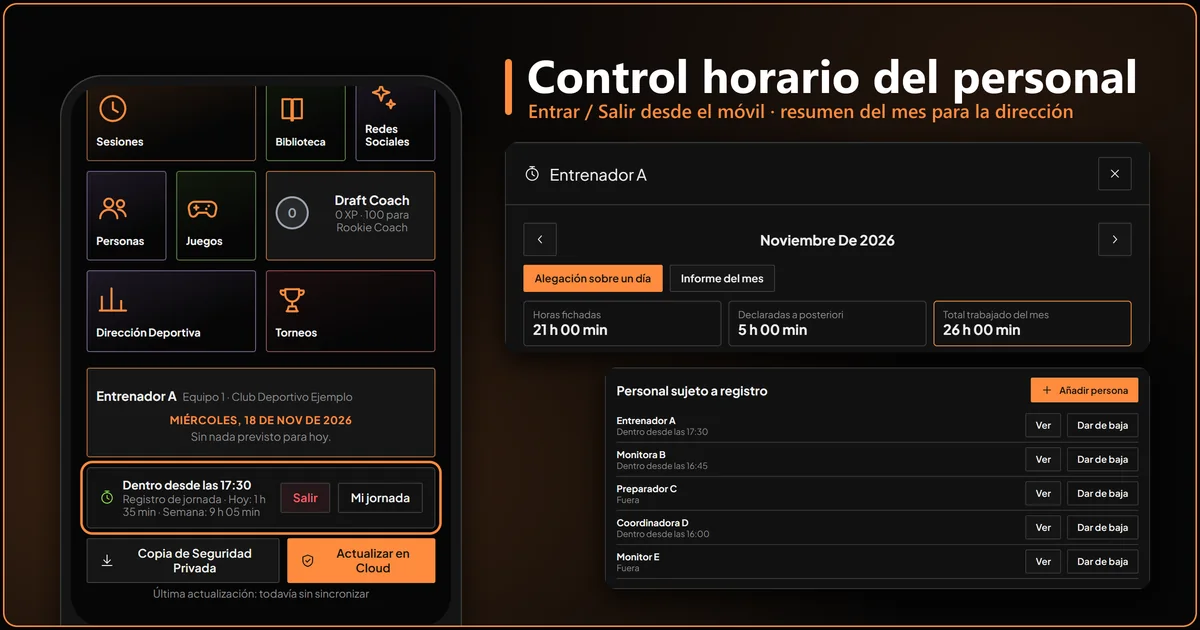
Time Tracking is a new PiSportDesk feature, which we are launching with a pilot club. It is designed for clubs that already run their sporting side in the app and have contracted staff. This is what it does today:
- Clock in and Clock out. Each person clocks in with their own club account, from the app's Home screen. The time is set by the server, not by the phone's clock. You cannot clock in offline: you do it once you are back online, or declare it afterwards.
- Corrections for forgotten entries. If someone forgets to clock in, they declare the time afterwards with a reason, and the club's director approves or rejects it. The decision is recorded; to correct it, the person makes a new declaration, without deleting anything.
- Monthly report with two signatures. Each month there is a report per person with clocked time, declared and approved time, pending time and the total recorded. Both the person and the club sign it in the app, and it can be exported as CSV or printed to PDF.
- Audited director access. Only the club's director can view the records of all staff, and every view is logged: the person concerned can see who looked at their record and when. The club never clocks in or declares hours on someone else's behalf.
- Verifiable fingerprint. Each entry carries a fingerprint chained to the previous one, so a later change can be detected.
One difference from the rest of PiSportDesk: almost the whole app works offline and stores data on your device, but Time Tracking does not. Records are stored only on the server and not on the phone, precisely so that the time and the history do not depend on each device.
It is included in Club Cloud at no extra cost: the module is not charged separately. On the other plans it is visible but locked. You can see what each plan includes on the pricing page. A tool helps you keep the working-time record (Art. 34.9 of the Workers' Statute), but it does not replace your employment adviser: how the record is organised at your club, the collective agreement and the information given to staff are still the club's decisions. If you want to see how it fits with the rest of the work at a multi-team club, we cover that in how to manage a multi-team club without losing control and in one app for your club's whole sporting side. The app's latest features are in the latest PiSportDesk product updates.
Club Cloud brings the club's sporting side and time tracking for its contracted staff together in one app, without adding another tool.
Try PiSportDesk freeReferences
- Royal Legislative Decree 2/2015 of 23 October, approving the consolidated text of the Workers' Statute (Estatuto de los Trabajadores). Articles 34.9 and 12.4.c, consolidated text, in Spanish. BOE-A-2015-11430. Accessed November 18, 2026.
- Royal Decree-Law 8/2019 of 8 March on urgent social protection measures and combating precarious working hours. Articles 10 and 11 and sixth final provision, in Spanish. BOE-A-2019-3481.
- Royal Legislative Decree 5/2000 of 4 August, approving the consolidated text of the Law on Social Order Infringements and Penalties (LISOS). Article 7.5, consolidated text, in Spanish. BOE-A-2000-15060. Accessed November 18, 2026.
- Ibid., Article 40.1.b, consolidated text, in Spanish. BOE-A-2000-15060. Accessed November 18, 2026.
- Law 45/2015 of 14 October on Volunteering. Article 3, consolidated text, in Spanish. BOE-A-2015-11072. Accessed November 18, 2026.