From 3-1 to 4-0 in Futsal: How and When to Transform Your Attacking System
Few tactical decisions change the face of a futsal attack as much as switching from playing with a pivot to playing without one. The 3-1 and the 4-0 are not rival systems but two structures a mature team moves between, depending on what the opponent gives it. This guide explains why to make that transformation, how to execute it with specific tactical tools, when to use it and which collective rules make it work.
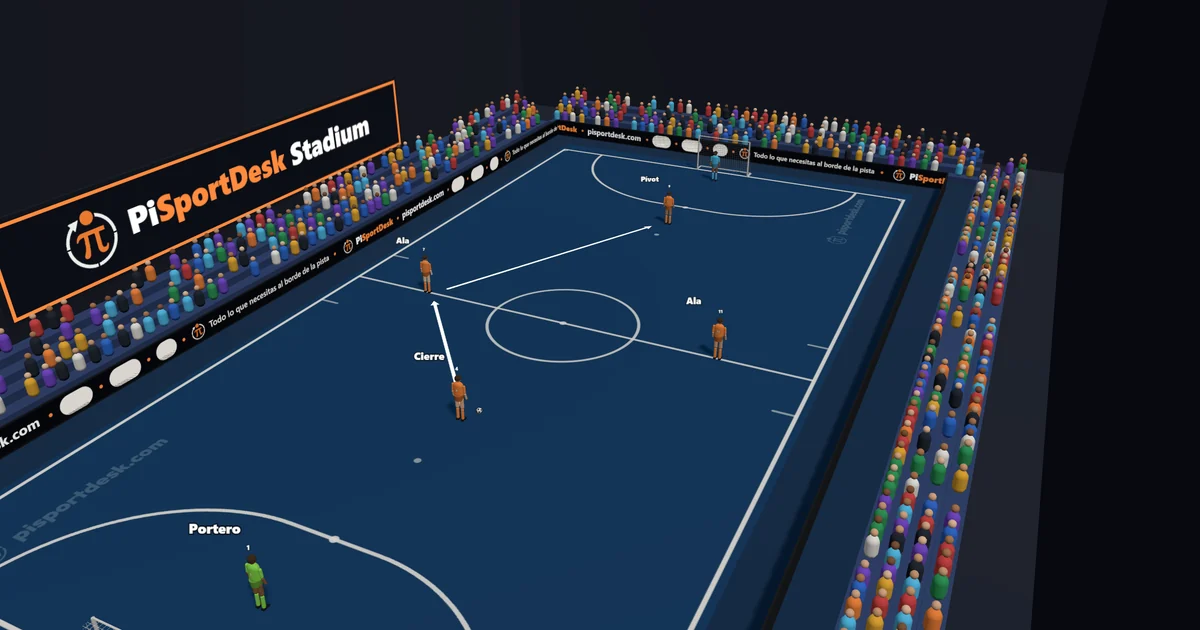
A quick note on terms: in a 3-1 the back (the Spanish cierre, also called the fixo) starts the play, the two wingers (alas) build it, and the pivot plays highest up, near the opponent's goal.
Why transform the 3-1 into a 4-0
In modern futsal, the ability to disorganise the opponent's defensive structure depends directly on how fluid and adaptable your positional attack is. Within the conceptual framework of the Escuela Terra F.S. and the methodology manuals of Spain's Liga Nacional de Fútbol Sala (LNFS), the transformation between the 3-1 system and the 4-0 set-up is one of the most decisive tactical steps for creating numerical and spatial superiority. Where the 3-1 gives a clear reference in depth thanks to the pivot, the 4-0 removes that fixed reference and puts all four outfield players on the same dynamic line, forcing the opposing defence out of its comfort zone and changing its patterns of help.
Mastering the transition between the two structures lets a team alternate between pinning the opposing back directly and playing with constant movement, turning a predictable attack into an unpredictable one. Below are the theoretical foundations, the step-by-step collective movements and the match situations in which this transformation should be used to get the most out of it on court.
1. Methodological foundations and tactical reasons for the transformation
Moving from 3-1 to 4-0 is not an aesthetic whim but a tactical and cognitive need, based on breaking down the opponent's defensive systems. In the traditional 3-1, the attacking structure spreads the players over three lines (the back in the build-up zone, the wingers in the creation zone and the pivot in the finishing zone). Although this naturally guarantees width and depth, it allows the opponent to set up stable defensive triangles and clear cover around the pivot.
By shifting the attack into a 4-0, the attacking team removes the fixed reference from the opponent's area, through the pivot's movement or the wingers' staggered positioning, producing these immediate tactical effects:
- No more traditional defensive cover: with all four players in the first line or in a dynamic staggered line, the geometry of the opposing defensive triangle breaks down, forcing their backs to leave their natural position and press in areas far from goal.
- Attacking the "marking switch" and changes of direction: without a fixed mark, man-to-man defences with switches, and zonal defences, become uncertain. When a defender jumps out to press the passing lane, direct lanes open up behind the pressing team.
- Creating and exploiting space in depth: with four players in line pushing the defenders back towards the halfway line, any run in behind (a cut or a run down the line) opens clear avenues towards the opponent's goal.
- Width and connected passing lanes: the ball carrier always has at least two clear options (a short support or a safety pass) plus a forward route on the diagonal or down the line.
In stage-based teaching, the Escuela Terra methodology sets the formal introduction of the 4-0 and its transformations in Stage 4 (cadete category, ages 14-15) through conditioned games. Later, in Stage 5 (juvenil category, ages 16-18), players reach the higher technical level and are expected to switch fluently between 2-2, 3-1 and 4-0 in any phase of the match.
2. Basic movements and tactical tools to execute the transition
To transform the 3-1 into a 4-0 cleanly and without losing defensive balance, the methodology sets out a series of movement patterns and group tactics for two and three players. The key is how the pivot leaves the advanced position, or how the first-line players fill the spaces that open up.
The pivot dropping as a "false pivot"
The most direct way from 3-1 to 4-0 is for the pivot to drop into the first line of build-up. This can be done in two main ways:
- Pivot dropping to the strong side (false pivot on the strong side): the pivot leaves the centre and comes short towards the ball carrier's flank. Level with the wingers and the back, the pivot completes a flat line of four. This drags the defending back out of the area or forces them to hand the mark over to a winger.
- Pivot dropping to the weak side (false pivot on the weak side): the pivot moves out to the wide lane away from the ball. This empties the centre of the court completely and, after the back switches play, lets the team make a clean diagonal cut or a run down the line through the freed central channel.
| Tactical movement | How it is executed | Main tactical aim |
|---|---|---|
| False pivot (strong / weak side) | The pivot drops from the 3rd line to the 1st line on the ball side or the opposite side. | Break up the back's marking and form the line of 4 attackers. |
| Appearing between the lines | A winger or the back cuts into the middle between the opponent's 1st and 2nd defensive lines. | Break the opponent's zonal shift and receive facing forward. |
| Double cut from the centre | Two attackers cross their runs diagonally in opposite directions after a pass. | Create uncertainty and errors in the opponent's marking switches. |
| One-two and run down the line | The passer plays short to the support between the lines and runs down the flank. | Exploit the space behind the defender who jumps out to press. |
| Overlap and balance | The passer runs behind the ball carrier to keep the team balanced. | Keep defensive cover if the move cannot progress. |
The double cut and rotation sequence in 4-0
Once the team is set in a 4-0, keeping possession relies on continuous movement ("pass and move"). A standard progression sequence works like this:
- Opening pass and switch: the back in the first line (player 1) plays short to their line partner (player 2) to pin the first pressing block.
- Cut between the lines after a feint: player 1 feints outwards and then sprints diagonally towards the centre of the court (appearing between the lines). If the opponent marks man-to-man, the cut can go in front of or behind the defender depending on how they are positioned.
- Opening and filling the space: while player 1 breaks into the middle or down the line, the advanced winger on the far side (player 4) moves up into the vacated lane, keeping the far-post pass available.
- Defensive balance and reorganisation: the deepest winger (player 3) overlaps behind the ball line towards the centre of the court, taking on the defensive balance role to prevent counter-attacks if the ball is lost.
3. Key match situations and criteria by development stage
Using the 3-1 to 4-0 transformation must respond to the match context and the type of defence the opponent presents. The point is not to play permanently in 4-0, but to use the transformation as a specific tactical answer to three key scenarios.
Playing out against aggressive three-quarter or full-court pressing
When the opponent presses high (1-2-1 or 1-1-2 defensive systems) with strict man-to-man match-ups, a fixed pivot can suffocate the goalkeeper's restart by crowding too many players into small spaces.
- How to use it: the team starts in a 3-1. On the goalkeeper's signal, the pivot cuts diagonally into the first line, turning the structure into a 4-0 just before or immediately after the restart.
- Advantage: this forces the opposing backs to push their line up to halfway. With all four defenders on the same horizontal line, any feint with a directional first touch or a lofted pass down the line creates a 1v1 in open space or a 2v1 towards goal.
Positional attack against deep or half-court defences
Against defensive blocks sitting back at 6 or 8 metres (2-2 systems or compact diamonds), the 3-1 can get stuck if the opposing back dominates the physical battle with the pivot, who plays with their back to goal.
- How to use it: the pivot leaves the area and joins the perimeter circulation as a false pivot. With quick two-touch passing and continuous rotations in 4-0, the ball travels from flank to flank.
- Advantage: the deep defence is forced into constant lateral shifts. The moment an opposing winger arrives late to close down outside, the team changes pace or snaps back into a 3-1 (inserting a direct cut into the area) to finish first time or attack the far post.
Teaching criteria by age category
- Cadete stage (ages 14-15): the focus is on understanding free space. Players must learn to spot when the pivot should "empty" towards the flank and how the winger should fill that lane. Priority goes to the receiving feint and the backward safety pass when there is no forward line.
- Juvenil and senior stage (ages 16-18 and up): players refine their reading of the defender's "blind spots" and their perception of the opponent's stronger foot. They must master third-player variations and spot the exact moment to break the 4-0 with a long-range shot, a worked diagonal move or a one-two continuing through the middle.
4. Essential tactical rules to make the 4-0 work
For the 3-1 to 4-0 transformation to be truly competitive and not turn into sterile, harmless possession, the coaching staff must instil five non-negotiable tactical rules:
- Always feint and receive on the move: standing still in the line of 4 makes the pressing defence's job easy. Every reception should come after a feint and be taken with a directional first touch towards the stronger foot or the free lane.
- Exploit the defender's blind spot: cuts between the lines and double cuts should start behind the direct marker's field of vision, forcing them to turn their head and lose sight of the ball.
- Respect the principle of continuity ("pass and move"): a pass with no movement afterwards kills the dynamics of the 4-0. Every player who releases the ball must start a diagonal run, a run down the line or an overlap to secure balance.
- Draw them to one lane to strike in the other: circulation in 4-0 aims to pull the defensive block towards one flank (the strong side) with short passes and pinning, then switch sharply to the diagonal or the weak-side winger.
- Always keep defensive balance covered: the team must always have one player behind the ball line. If a first-line player joins the finish at the far post, the opposite winger must automatically drop back to the centre to prevent deadly counter-attacks.
In short, the tactical transformation from 3-1 to 4-0 represents the move towards dynamic, intelligent and versatile futsal. By mastering the false pivot's movements, the smart occupation of the inside channels and the criteria for using it according to the opponent, coaches gain an elite resource to take control of the match and turn possession into clear scoring chances.
How to prepare it in PiSportDesk
A system transformation is much easier to understand in motion than on paper. On the PiSportDesk tactics board you can draw the starting 3-1 on a regulation futsal court and save one capture per step: the pivot dropping, appearing between the lines, the double cut and the balance. The fluid player links the captures so players can see how the line of 4 forms and who fills each lane. Then the drill goes into your futsal library and into the week's sessions, tied to the block plan, as we explain in how to plan a youth futsal season.
On the Pro Cloud and Club Cloud plans, the same play can also be viewed in 3D, which helps players perceive angles and spaces from inside the court, and you get access to the Professional Futsal content structure. If you also coach other sports, what team sports share shows how these principles (pin, release, fill the space that opens up) appear in all of them. Plans are on the pricing page.
Draw the play capture by capture on a futsal court, play it back fluidly and save it to your library. Start with the Free plan.
Try PiSportDesk free