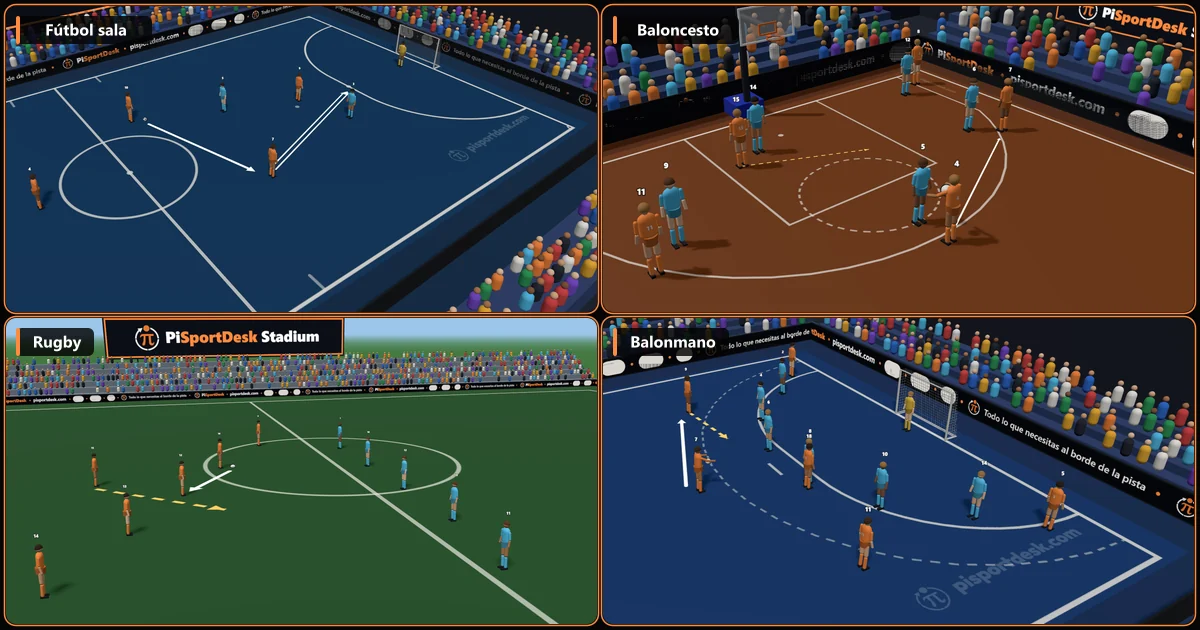
What Futsal, Basketball, Handball, Rugby, Hockey and Football Share, and How They Feed Each Other
If you have coached more than one team sport, you have seen it many times: a futsal winger who instantly understands a basketball pick, a handball centre back who reads passing lanes like a football midfielder, or a rugby player attacking the gap between two defenders with the same idea a futsal pivot uses to pin the opposing defender. It is not a coincidence. Underneath very different rulebooks there is a common logic: two teams competing for a ball and for space, with one goal to attack and another to defend.
This article looks at those similarities from the court side, at the rules that set each sport apart, and at what research says about learning through several sports at once. It also covers the caveats, because transfer from one sport to another is real, but it is not automatic.
The game principles team sports share
Take away the ball, the stick or the goal and invasion games ask almost the same tactical questions. These are the ones that keep coming back:
- Smart use of space. Width to stretch the defence and depth to offer options ahead of and behind the ball. A team crowded around the ball carrier makes defending easy in any sport.
- Numerical and positional overloads. The 2v1, the 3v2 or simply being better positioned than the opponent are the basis of attacking play in all of them. Futsal and handball look for them through quick ball circulation; rugby by running at the defender's inside shoulder to commit him before releasing the ball.
- Passing and moving off the ball. Pass and move, offer a clean passing lane, come short to support or run in behind. The technique changes (foot, hand, stick); the idea does not.
- Support and the third player. The ball carrier should always have at least two passing options, and the move should not depend only on the receiver but on a third player arriving from outside the defender's view.
- Target or post play. A player with their back to goal near the opponent's target who receives, holds and lays off: the futsal pivot, the handball pivot, the low post in basketball or the target striker in football.
- Screens and picks. Freeing a teammate with your own body. Central in basketball and common in handball; in other sports the rules restrict it heavily, as we will see.
- Attack-defence transitions. The seconds after losing or winning the ball decide many matches. Dropping back or counter-pressing after a loss, and attacking fast before the opponent is organised, are decisions every team sport shares.
- Man-to-man, zonal or mixed defence, and pressing. Marking a player, defending a space or combining both, and deciding how high to press. Futsal coaches talk about half-court or full-court defence; basketball about full-court press; handball about systems such as 6-0, 5-1 or 3-2-1.
We covered several of these concepts for a single sport in basic football tactical principles for youth categories. The underlying idea is the same: principles come before systems.
The rules that change how each sport solves it
If the problems are similar, why does each sport look so different? Because of the rules. Every rulebook closes some solutions and opens others, and a good multi-sport coach can explain to players why something that works in one sport does not work in another:
- Rugby: the pass can only go backwards or flat. Ground is gained by running and kicking, never by passing forward. That is why support in rugby always comes from behind the ball carrier, the opposite of football or futsal. A player in front of the teammate who last played the ball is offside and cannot take part, and blocking a defender who is not carrying the ball is obstruction.
- Basketball: travelling, double dribble and time limits. You cannot move with the ball in your hands without dribbling, or dribble again once you have picked it up. That makes passing and dribbling two very different tools. Shot-clock and restricted-area time limits force the ball and the players to keep moving. And the screen, legal when the screener is stationary and in a legal position, is one of the game's main weapons.
- Handball: steps, bounces and the goal area. A player may only take a few steps holding the ball, cannot dribble again after catching it, and the goal area belongs to the goalkeeper alone. So the game revolves around the 6-metre line, with the pivot battling among the defenders and the back-court players shooting over or between them. Passive play rules also force teams to attack with intent.
- Football: offside. An attacker may not become involved in play if, when the ball is played, they are nearer the opponent's goal line than both the ball and the second-last defender, with exceptions such as being in their own half. This shapes how high a defence plays and the exact timing of runs in behind.
- Futsal: no offside, but four seconds. There is no offside, so depth can be occupied freely, but kick-ins, corners, goal clearances and free kicks must be taken within four seconds. Accumulated fouls limit how aggressively a team can press, and unlimited rolling substitutions keep intensity high.
- Field hockey: the circle and the stick. Only the flat side of the stick may be used, playing the ball with the foot is a foul, and a goal only counts if the shot is taken from inside the shooting circle. There is no offside either. The result is a game built on passing and movement, with entries into the circle as the tactical target.
The practical lesson is simple: the same principle, say "create a 2v1", is solved with a lateral pass in rugby, a pick and roll in basketball or a one-two in futsal. If players understand the principle, learning each sport's own solution costs them less.
Table: shared principles and sport-specific features
| Principle | What they share | What changes by sport |
|---|---|---|
| Numerical overload | Committing a defender to free a teammate | Backward pass in rugby; pick and roll in basketball; one-two in futsal and football |
| Depth | Having options ahead of the ball | Limited by offside in football and rugby; free in futsal, handball and field hockey |
| Post play | Receiving with your back to goal, holding and laying off | Outside the 6 m area in handball; time limit in the restricted area in basketball; no spatial restriction in futsal |
| Screens and picks | Freeing a teammate with your body | Main weapon in basketball and common in handball; obstruction in rugby; very limited in football |
| Transitions | Attacking or recovering in the seconds after winning or losing the ball | Pace set by the shot clock in basketball and by unlimited substitutions in futsal |
| Defence | Man-to-man, zonal or mixed; deciding how high to press | Accumulated fouls in futsal and suspensions in handball limit how much risk to take |
How players learn the game: transfer and game-centred teaching
For decades, team sports were taught by starting with isolated technique and leaving the game until the end. In 1982, Bunker and Thorpe proposed turning that around with a model now known as Teaching Games for Understanding (TGfU) [1]: start with an adapted game, understand the tactical problem it poses, and work on technique once players know what they need it for.
That approach fits well with everything above: if invasion games share tactical problems, a modified game can teach "create and exploit a 2v1" before anyone knows whether the player will end up on a futsal court or a rugby pitch. Along the same lines, the constraints-led approach proposes designing tasks by changing space, numbers or rules so that the game itself pushes players to discover solutions, rather than dictating them [2].
Small-sided games are the most direct tool for this: fewer players and less space mean more touches, more decisions per minute and more overload and underload situations. A 3v2 to two small goals works just as well for a futsal team as for a hockey team, changing only the implement. Futsal has even been proposed as a "donor" sport for football precisely because of this complementarity in perception and decision-making demands [3].
Why multi-sport practice needs to be managed in youth development
Playing several sports is not just a tactical matter. Done well, it shapes how players learn, how they feel and how they move. Done badly, it becomes an impossible schedule of sessions with no rest. That is why it is worth looking at from three angles.
Teaching: shared principles. Multi-sport clubs and schools can share a common language: width, depth, support, commit and release, counter-press. When a child hears the same concept in two different sports, it sticks. Research on early specialisation points the same way: the Developmental Model of Sport Participation by Côté and colleagues recommends a sampling stage, with a variety of sports and plenty of play, before specialising [4], and the International Olympic Committee consensus statement on youth athletic development also advises against early specialisation in most sports [5].
Psychology: motivation, identity and enjoyment. Côté's work highlights deliberate play and variety as the foundation of continued participation [4]. In their review of specialisation in young athletes, Jayanthi and colleagues link early specialisation with a higher risk of overuse injury and burnout [6]. A player whose identity rests on a single sport trained all year round experiences every bad run as an identity crisis; one who enjoys several sports has more ways to feel competent. Adult pressure, and how mistakes are talked about, matter as much as the calendar, as we discuss in communicating with young athletes.
Motor skills: a broader base. Coordination, balance, agility, laterality, throwing, striking, dribbling, receiving with hands and feet. Each sport develops a part of it, and several together widen the repertoire. Fransen and colleagues compared boys aged 6 to 12 who played one sport with others who sampled several, and in the oldest group the samplers showed better gross motor coordination and physical fitness [7]. The authors themselves note that it is a cross-sectional study: it does not show that variety is the cause.
And at the elite level? A meta-analysis by Güllich, Macnamara and Hambrick found that adult world-class athletes had practised more different sports in childhood and adolescence, and started their main sport later, than national-class athletes, although among young athletes those who specialised earlier stood out more [8]. In sports measured in centimetres, grams or seconds, Moesch and colleagues observed that elite athletes specialised later than their lower-level peers [9].
Caveats: transfer is not automatic
Let's be honest about the limits. Two sports sharing principles does not mean what is learned in one passes on to the other by itself:
- It depends on the task. What transfers best is what looks similar in perception and decision-making (reading an overload, seeing the gap), not specific technique. A basketball dribble does not improve dribbling with the feet.
- It depends on how it is taught. If the coach names the principle and compares it across sports, transfer is more likely. If each sport is taught as a world of its own, players rarely make the connection alone.
- There is interference. A rugby player used to never passing forward will take time to see the vertical pass in futsal, and a football player has to forget about offside. Plan for it.
- Total load matters. Two sports with a full calendar each can add up to too many hours. Diversifying is not training twice as much.
- Most evidence is observational. Many studies compare groups or reconstruct careers: they describe associations, not causes. Recommending variety is reasonable; promising champions is not.
How a shared tool helps you see the same principle across sports
In practice, teaching through principles means comparing. Seeing the same 2v1 drawn on a futsal court and on a rugby pitch, or the same post play in handball and basketball, makes it obvious what is shared and what changes. That is hard to do if each sport lives in a different app or notebook.
PiSportDesk was built for exactly that: it covers more than 10 sports, each with its real court or pitch on the tactics board, its own task library organised by content structure, and its sessions. The same overload drill can be drawn for several sports, animated step by step and saved in each sport's library. On the Pro Cloud and Club Cloud plans, the play can also be viewed in 3D, which really helps players understand how space is occupied. For clubs with several sections, keeping everything on one shared base is what we describe in one app for your club's whole sporting side. If you want to try it, the Free plan lets you start with one team, and the other plans are on the pricing page.
PiSportDesk brings a tactics board with each sport's real court, a task library and sessions together in one app that works offline and without an account.
Try PiSportDesk freeReferences
- Bunker, D. & Thorpe, R. (1982). A model for the teaching of games in secondary schools. Bulletin of Physical Education, 18(1), 5–8. No DOI; text of the model reproduced by the University of Victoria.
- Renshaw, I., Chow, J. Y., Davids, K. & Hammond, J. (2010). A constraints-led perspective to understanding skill acquisition and game play: a basis for integration of motor learning theory and physical education praxis? Physical Education and Sport Pedagogy, 15(2), 117–137. doi.org/10.1080/17408980902791586.
- Travassos, B., Araújo, D. & Davids, K. (2018). Is futsal a donor sport for football? Exploiting complementarity for early diversification in talent development. Science and Medicine in Football, 2(1), 66–70. doi.org/10.1080/24733938.2017.1390322.
- Côté, J., Lidor, R. & Hackfort, D. (2009). ISSP position stand: To sample or to specialize? Seven postulates about youth sport activities that lead to continued participation and elite performance. International Journal of Sport and Exercise Psychology, 7(1), 7–17. doi.org/10.1080/1612197X.2009.9671889.
- Bergeron, M. F., Mountjoy, M., Armstrong, N., Chia, M., Côté, J., Emery, C. A. et al. (2015). International Olympic Committee consensus statement on youth athletic development. British Journal of Sports Medicine, 49(13), 843–851. doi.org/10.1136/bjsports-2015-094962.
- Jayanthi, N., Pinkham, C., Dugas, L., Patrick, B. & LaBella, C. (2013). Sports specialization in young athletes: evidence-based recommendations. Sports Health, 5(3), 251–257. doi.org/10.1177/1941738112464626.
- Fransen, J., Pion, J., Vandendriessche, J., Vandorpe, B., Vaeyens, R., Lenoir, M. & Philippaerts, R. M. (2012). Differences in physical fitness and gross motor coordination in boys aged 6–12 years specializing in one versus sampling more than one sport. Journal of Sports Sciences, 30(4), 379–386. doi.org/10.1080/02640414.2011.642808.
- Güllich, A., Macnamara, B. N. & Hambrick, D. Z. (2022). What makes a champion? Early multidisciplinary practice, not early specialization, predicts world-class performance. Perspectives on Psychological Science, 17(1), 6–29. doi.org/10.1177/1745691620974772.
- Moesch, K., Elbe, A.-M., Hauge, M.-L. T. & Wikman, J. M. (2011). Late specialization: the key to success in centimeters, grams, or seconds (cgs) sports. Scandinavian Journal of Medicine & Science in Sports, 21(6). doi.org/10.1111/j.1600-0838.2010.01280.x.