

The Futsal Double Penalty and the Handball 7-Metre Throw: How They Work and How They Differ
On an indoor court, a penalty is not just a penalty. Futsal has two shots at goal with no wall, and the one Spanish players call the doble penalti ("double penalty") is not a penalty kick at all. Handball has its own 7-metre throw, with rules on the goalkeeper and the thrower that often cause doubts. Here are both, with the rulebook open, and at the end a futsal and handball penalty game to try them.
The futsal penalty kick (6 m) and the double penalty (10 m)
The FIFA Futsal Laws of the Game 2025/26 put two marks in front of each goal: the penalty mark, 6 metres from the midpoint between the goalposts, and the 10 m mark, also known as the second penalty mark (Law 1).
The penalty kick
It is mainly given when a player commits a direct free kick offence inside their own penalty area (Law 14). It is taken from the 6 m mark, and the goalkeeper stays on the goal line, between the posts and facing the kicker, until the ball is kicked.
Accumulated fouls
These are the fouls penalised with a direct free kick, counted per team and per half; in extra time, the fouls from the second half keep counting (Law 13). A detail that often causes doubts: under Law 12, no accumulated foul is recorded when a penalty kick is awarded.
The double penalty
From a team's sixth accumulated foul in a half, and for every one after it, the opponents take a special direct free kick (Law 13). If the foul is inside the offender's penalty area, a penalty kick is given instead. Otherwise:
- Where from. From the 10 m mark. If the foul was committed between the end line and the imaginary 10-metre line, the team can choose between the mark and the place of the foul.
- No wall. The other players stay behind the ball, outside the penalty area and at least 5 metres away.
- The goalkeeper must be at least 5 metres from the ball until it is kicked; with the ball on the 10 m mark, a mark in the penalty area shows how far they may come out.
- A shot on goal. The kicker must try to score directly: passing is not allowed. Nor may they touch the ball again until another player has touched it.
The handball 7-metre throw
Rule 14 of the IHF Rules of the Game (2022 edition) covers it, and the Spanish version of the rules dated 1 July 2025 matches it on everything below.
- When it is given. Mainly when a player or team official of the opposing team illegally destroys a clear chance of scoring anywhere on the court; also, for example, when an unwarranted whistle or someone not taking part in the game interrupts it. If the attacker keeps full control of ball and body despite the foul, there is no 7-metre throw.
- The thrower stands behind the 7-metre line, a 1-metre-long mark, no more than 1 metre behind it. They have 3 seconds from the whistle to shoot at goal and, after the whistle, may not touch or cross the line until the ball has left their hand. As with any throw, part of one foot stays on the floor until release (Rule 15).
- The goalkeeper may not cross the goalkeeper's restraining line, the 4-metre line, until the ball has left the thrower's hand (Rule 5). With one foot on the floor on or behind the line, they may move the other foot or their body over it in the air. If they cross it too early and no goal is scored, the throw is retaken, with no personal punishment.
- Everyone else waits outside the free-throw line (9 metres); opponents must also stay at least 3 metres from the 7-metre line.
Quick comparison
| Aspect | Double penalty (futsal) | 7-metre throw (handball) |
|---|---|---|
| Distance | 10 m mark or, in some cases, the place of the foul | 7-metre line |
| What causes it | A team's sixth accumulated foul in the half, and every one after it | Mainly, illegally destroying a clear chance of scoring |
| Who takes it | An identified player, who must try to score directly | One player, within 3 s of the whistle |
| Goalkeeper | At least 5 m from the ball until it is kicked | May not cross the 4 m line until the ball leaves the hand |
| Goal | 3 × 2 m | 3 × 2 m |
The goal is the same size (Rule 1 in both rulebooks). What changes most is the goalkeeper: in futsal they can come much further out towards the ball; in handball, the 4-metre line sets the limit.
Three common mistakes by shooters
Nothing guarantees a goal, but some mistakes come up at every age group and can be worked on:
- Shooting without having decided. Changing your mind on the last step usually ends in a shot without conviction. A short routine and choosing the zone before starting help.
- Being predictable. The same side, the same rhythm and the same run-up all give the goalkeeper information. It pays to have more than one option and to practise them all.
- Losing it to the rules. In handball, stepping on the line after the whistle, lifting the standing foot before release or going over the 3 seconds. In futsal, not shooting at goal on the double penalty, or touching the ball again before another player does.
To practise, the most useful approach is to train under match conditions: the real distance, a whistle, a goalkeeper with their limits and some pressure, for example in a shootout between pairs.
Try it in the game
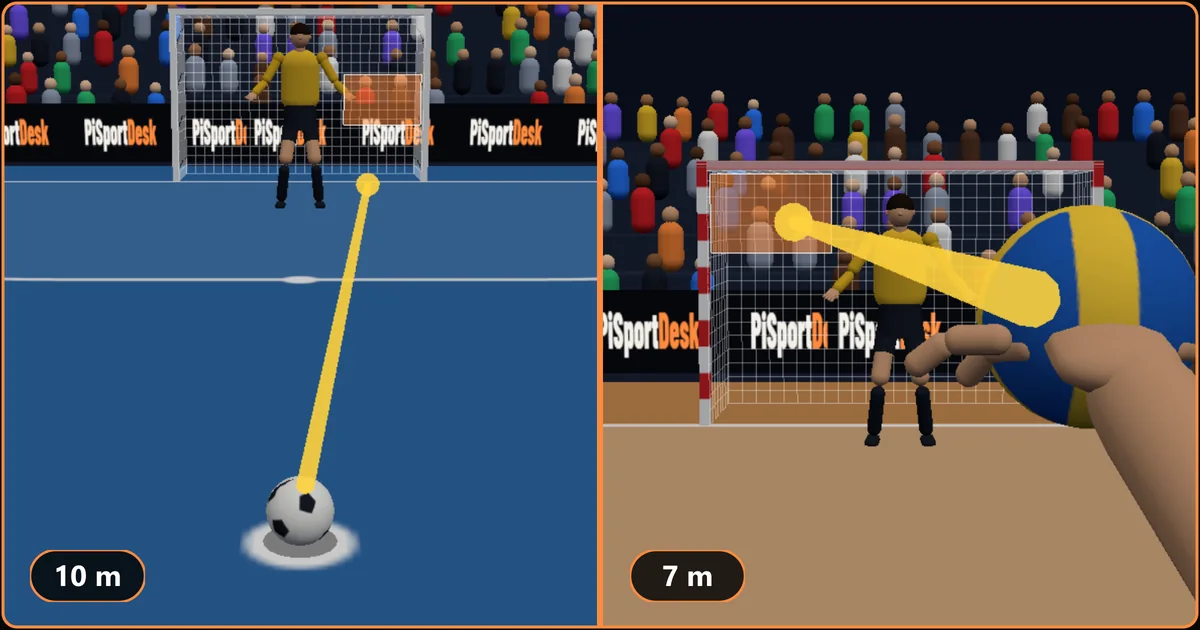
PiSportDesk Penalty Shootout 3D is a free game that opens in your browser, with no account and no download: the futsal double penalty from 10 metres, with the goalkeeper up to 5 metres off their line, and the handball 7-metre throw, with the goalkeeper up to the 4-metre line. A best-of-5 shootout, alone against the computer or two players on one phone. It recreates the shot and the save; it does not reproduce the rest of a match, is not a rules simulation, and has no connection with FIFA, the IHF or any federation. You can go straight to play futsal or play handball.
The futsal double penalty and the handball 7-metre throw in 3D, free and with no account.
Try it in the gameSources
- FIFA (2025). Futsal Laws of the Game 2025-26. Laws 1 (the pitch), 12 (fouls), 13 (free kicks) and 14 (the penalty kick). digitalhub.fifa.com (PDF).
- IHF (2022). Rules of the Game: Indoor Handball, 1 March 2022 edition. Rules 1, 5, 14 and 15. ihf.info (PDF).
- Reglas de Juego de Balonmano Pista, Spanish version dated 1 July 2025. Rules 1, 5, 14 and 15. Published by the Canary Islands Handball Federation: fecanbm.es (PDF, in Spanish).
This article summarises the international rules as of November 23, 2026. For your own competition, your federation's rulebook and regulations always prevail, and they may adapt these rules, especially in youth categories.